TypeScript
Elysia has first-class support for TypeScript out of the box.
Most of the time, you wouldn’t need to add any TypeScript annotations manually.
Inference
Section titled “Inference”Elysia infers the type of request and response based on the schema you provide.
import { Elysia, t } from 'elysia'import { z } from 'zod'
const app = new Elysia()    .post('/user/:id', {        body: t.Object({            id: t.String()        }),        query: z.object({            name: z.string()        })    }, ({ body }) => body)
Elysia can automatically infer types from schema like TypeBox and your favorite validation library like:
- Zod
- Valibot
- ArkType
- Effect Schema
- Yup
- Joi
Schema to type
Section titled “Schema to type”All schema libraries supported by Elysia can be converted to TypeScript types.
TypeBox
Section titled “TypeBox”import { Elysia, t, type UnwrapSchema } from 'elysia'
const User = t.Object({ id: t.String(), name: t.String()})
type User = UnwrapSchema<typeof User>import { z } from 'zod'
const User = z.object({ id: z.string(), name: z.string()})
type User = z.infer<typeof User>Valibot
Section titled “Valibot”import * as v from 'valibot'
const User = v.object({ id: v.string(), name: v.string()})
type User = v.InferOutput<typeof User>ArkType
Section titled “ArkType”import { type } from 'arktype'
const User = type({ id: 'string', name: 'string'})
type User = typeof User.inferType performance
Section titled “Type performance”Elysia is built with type inference performance in mind.
Before every release, we have a local benchmark to ensure that type inference is always snappy, fast, and doesn’t blow up your IDE with a “Type instantiation is excessively deep and possibly infinite” error.
Most of the time when writing Elysia, you wouldn’t encounter any type performance issue.
However, if you do, here is how to break down what’s slowing down your type inference:
- Navigate to the root of your project and run
tsc --generateTrace trace --noEmit --incremental falseThis should generate a trace folder in your project root.
- Open Perfetto UI and drag the
trace/trace.jsonfile
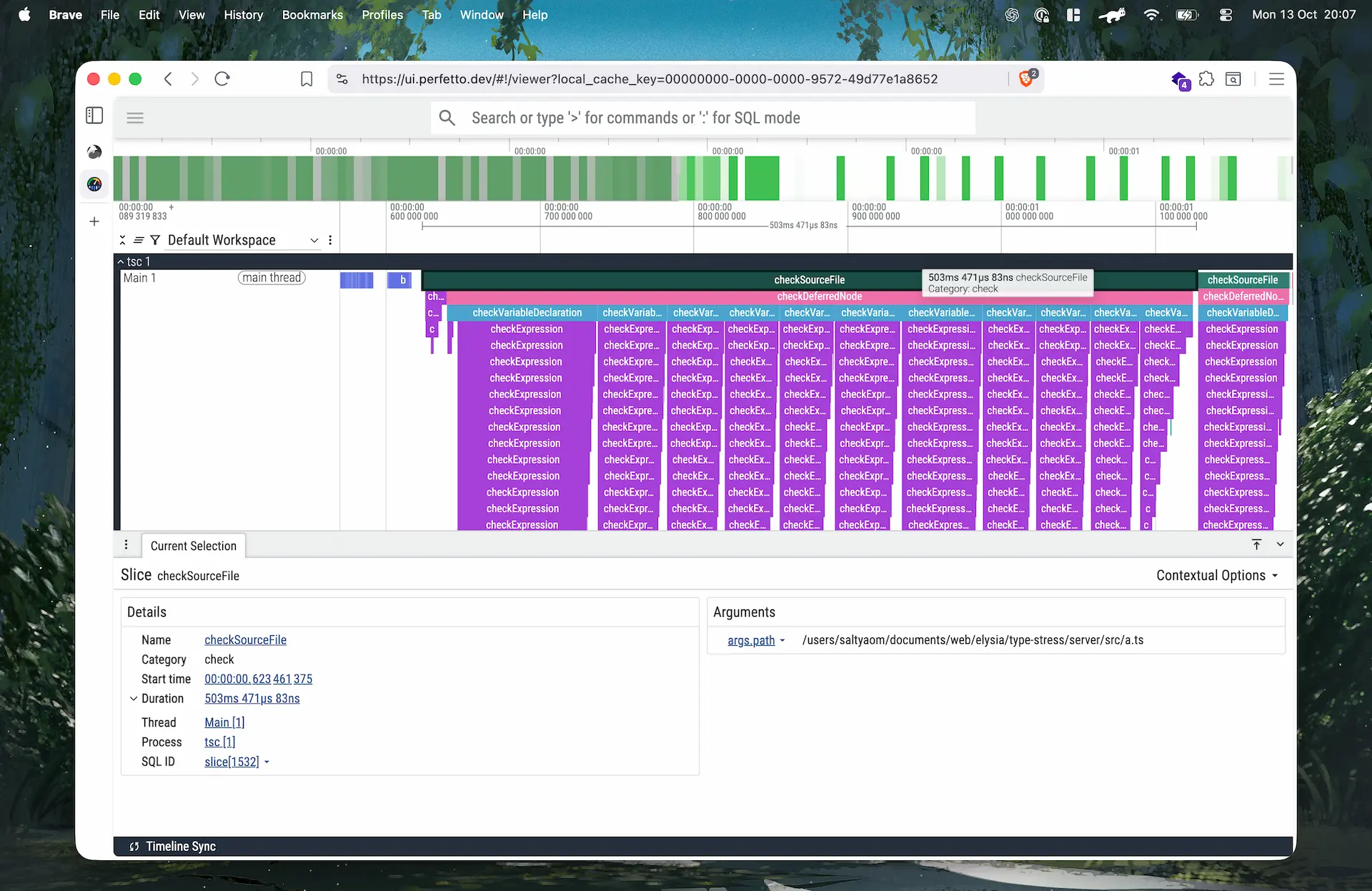
It should show you a flame graph like this
Then you can find a chunk that takes a long time to be evaluated. Click on it and it should show you how long the inference takes, and which file and line number it is coming from.
This should help you to identify the bottleneck of your type inference.
If you are having a slow type inference issue when using Eden, you can try using a sub app of Elysia to isolate the type inference.
import { Elysia } from 'elysia'import { plugin1, plugin2, plugin3 } from './plugin'
const app = new Elysia()  .use([plugin1, plugin2, plugin3])    .listen(3000)
export type app = typeof app
// Export sub appexport type subApp = typeof plugin1
And on your frontend, you can import the sub app instead of the whole app.
import { treaty } from '@elysia/eden'import type { subApp } from 'backend/src'
const api = treaty<subApp>('localhost:3000')
This should make your type inference faster as it doesn’t need to evaluate the whole app.
See Eden Treaty to learn more about Eden.